
Plot
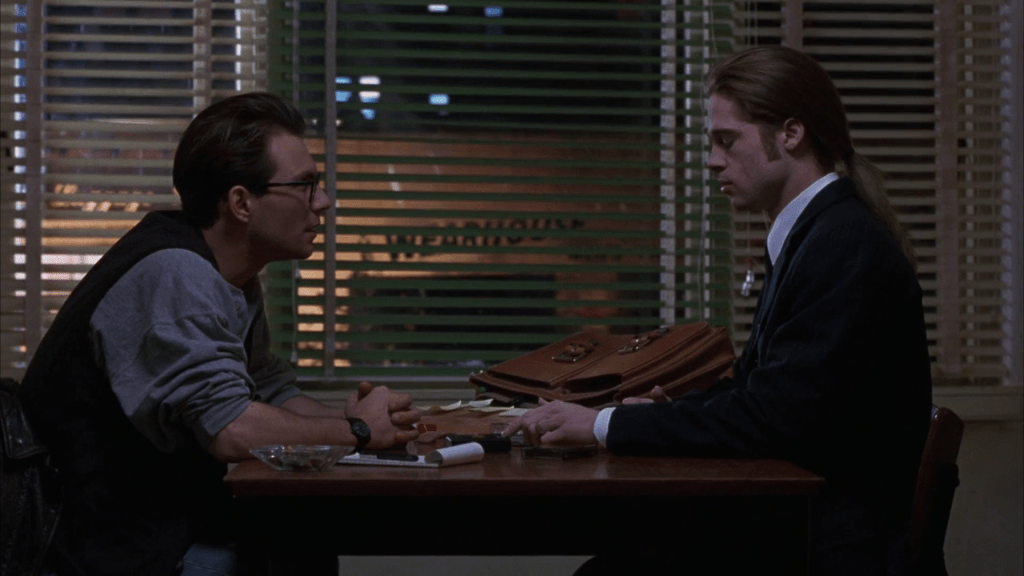
Louis claims he is a centuries old vampire, and decides to tell his story to a journalist he has met.
He tells the tale of his inception at the hands of Lestat, and their ventures through America and Europe in the Seventeen and Eighteen Hundreds.
Direction/Cinematography
Directed by Neil Jordan with Cinematography by Philippe Rousselot.
The use of practical effects, as well as amazing sets, designs throughout the 1700’s and 1800’s are a joy to view, complemented by the year the film was made. Had it been filmed a decade later, it would have been ruined by CGI.
It was nominated for two Oscars, Set Design and Score (by Elliot Goldenthal).
Cast/Characters
Brad Pitt plays Louis. This was really at the start of his stardom, and his nuanced performance; the almost boredom of telling his story as a centuries old vampire to Malloy, to his ‘birth’ as a vampire – his unwillingness to kill the innocent, and his quest for survival – proves he is a solid and talented actor.
Tom Cruise plays Lestat, clearly vehicle change for him – as he was in his action heyday at the time (and would go on to be a bigger superstar a few years later with his Mission Impossible franchise).
Kirsten Dunst plays Claudia, the child that the pair turn into a vampire, who they live with for over 30 years.
Other cast members include Christian Slater as Malloy who interviews Louis (a role reportedly written for River Phoenix, who died before filming began), Antonio Banderas as Armand, and Stephen Rea as Santiago.
Breakdown
Told in a ‘broken’ linear fashion, we meet an ‘interviewer’ named Malloy, who begins an interview with a man who claims he is centuries old, having lost his wife and child back in 1791. He is ‘created’ to become a vampire by Lestat.
At times the story is jolted from Luis point of view, back to the ‘current’ day – at times it is quite jolting – but it works.
From the universe created by Anne Rice, her versions of vampire lore is quite similar to those of traditional, with some changes – crucifixes and stakes don’t work, they do sleep in coffins, and they must not drink from someone who’s heart has stopped beating.
The Gothic sets of the 18/1900s are quite spectacular (and nominated for an Oscar), and rely more on practical effects as it predates the technology of CGI and special effects. However ‘some’ use of computer effects are solid (even for over 30 years later) such as when Claudia is ‘birthed’ and she becomes bewitched in her vampire body.
The main plot of the film is Luis’ inability to become a true vampire. He struggles with his blood-lust – killing animals instead of people. This causes Lestat much anguish. This all changes when Luis meets young Claudia, and feeds from her, and Lestat is the one who changes her. She then becomes the prodigy Lestat always wanted.
The ‘trio’ spend “thirty years” together in their timeline – but a fraction of that in on screen time. Claudia longs to be able to grow into adulthood, and grows to resent the pair for creating her to be their ‘doll’.
Her ‘attack’ on Lestat (where she tricks him to drink from dead bodies) is brutal in the instant and bloody reaction it causes Lestat (seriously the make up department deserves some recognition here) – and Lestat is ‘left for dead’ following this for the remainder of the film. From his bloody reaction, and to being burned alive by the pair is simply breathtaking.
Dunst is simply terrific in this arc, considering she was only 12 when she made this. I’ve reviewed her quite a few times, and she is one of the few child to adult stars who have never really faltered or had a down in their career.
The third act, in which Luis and Claudia discover a family of vampires in Paris – led by Armand and his right hand Santiago. This leads to the ‘sniff’ death of Claudia – just as she got her own companion – and the brutal reaction of Luis against the Paris vampires (and it is brutal!)
If I could have asked for something more, I would have like to see more of the ‘lust’ between Luis and Lestat – but I feel as though a 1994 audience (and perhaps the say of one of the main cast?) might have put an end to this. I would have like a better understanding of the timeline, as this is only briefly explained on what year things happened.
Overall
Solid adaptation of Anne Rice’s novel, with some strong performances from both Pitt and Cruise, but the standout is twelve year old Kirsten Dunst (who has gone on to have such a stellar career).
Great direction, with amazing sets and a brilliant score too. A bit more attention to the source material (the lust between Luis and Lestat) and better display of the year in which arcs occur would have been beneficial.
Very strong recommend.
4/5
Please also check out my Podcast on Youtube, where we review a new movie every week! Please subscribe!https://www.youtube.com/@MovieChatswithAntandRy
 Ryan's Movie Reviews